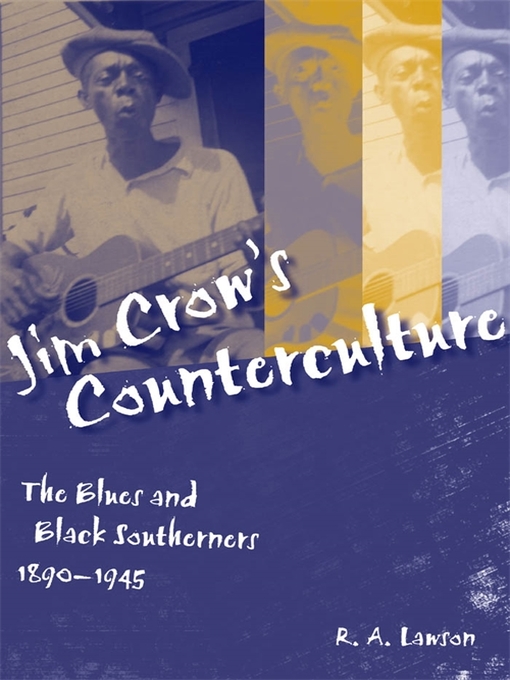
In the late nineteenth century, black musicians in the lower Mississippi Valley, chafing under the social, legal, and economic restrictions of Jim Crow, responded with a new musical form — the blues. In Jim Crow's Counterculture, R. A. Lawson offers a cultural history of blues musicians in the segregation era, explaining how by both accommodating and resisting Jim Crow life, blues musicians created a counterculture to incubate and nurture ideas of black individuality and citizenship. These individuals, Lawson shows, collectively demonstrate the African American struggle during the early twentieth century.
Derived from the music of the black working class and popularized by commercially successful songwriter W. C. Handy, early blues provided a counterpoint to white supremacy by focusing on an anti-work ethic that promoted a culture of individual escapism — even hedonism — and by celebrating the very culture of sex, drugs, and violence that whites feared. According to Lawson, blues musicians such as Charley Patton and Muddy Waters drew on traditions of southern black music, including call and response forms, but they didn't merely sing of a folk past. Instead, musicians saw blues as a way out of economic subservience.
Lawson chronicles the major historical developments that changed the Jim Crow South and thus the attitudes of the working-class blacks who labored in that society. The Great Migration, the Great Depression and New Deal, and two World Wars, he explains, shaped a new consciousness among southern blacks as they moved north, fought overseas, and gained better-paid employment. The "me"-centered mentality of the early blues musicians increasingly became "we"-centered as these musicians sought to enter mainstream American life by promoting hard work and patriotism. Originally drawing the attention of only a few folklorists and music promoters, popular black musicians in the 1940s such as Huddie Ledbetter and Big Bill Broonzy played music that increasingly reached across racial lines, and in the process gained what segregationists had attempted to deny them: the identity of American citizenship.
By uncovering the stories of artists who expressed much in their music but left little record in traditional historical sources, Jim Crow's Counterculture offers a fresh perspective on the historical experiences of black Americans and provides a new understanding of the blues: a shared music that offered a message of personal freedom to repressed citizens.
- Arab American Heritage Month
- Autism Awareness Month
- Pretty in Pink (National Pink Day April 10)
- National Librarian Day (April 16) 2026
- National Poetry Month 2026
- Earth Day
- Roll for Reading
- A Bouquet of Books: Fabulous Floral Covers
- NYT Best Sellers 2025
- In Memoriam
- Freedom to Read- Banned Books
- New eBook additions
- Level Up at Your Library!
- See all ebooks collections
- Arab American Heritage Month
- Autism Awareness Month
- National Poetry Month 2026
- A Bouquet of Books: Fabulous Floral Covers
- Pretty in Pink (National Pink Day April 10)
- National Librarian Day (April 16) 2026
- Roll for Reading
- Earth Day
- NYT Best Sellers 2025
- Freedom to Read- Banned Books
- Dive In, If You Dare
- Level Up at Your Library!
- All You Have to Do Is Call: Friendship Reads
- See all audiobooks collections
- #ownvoices / Diverse Books
- Antiracism Resources
- Sheet Music & Song Books
- Bücher auf Deutsch / Books in German
- Civil Service Test Prep
- The Great Courses
- QuickReads Collection
- See all featured collections collections